
What is Living Gravel?
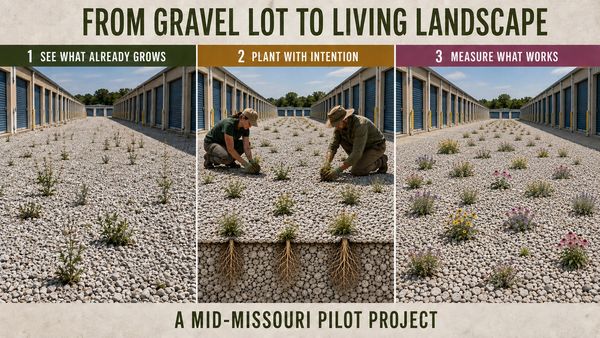
A Mid-Missouri Pilot Test
The Living Gravel Project.
Can nature help us build a better gravel surface?
Millions of property owners use gravel for driveways, parking areas, storage yards, access roads and other improved surfaces. Gravel is relatively inexpensive, permeable and practical.
But gravel has problems.
Rainwater moves it. Stormwater carries it away. Traffic creates ruts. Maintaining it requires periodically grading the surface and purchasing and spreading replacement gravel.
At the same time, property owners routinely spend money and labor trying to prevent something that nature continuously tries to do.
Nature grows plants in gravel.
We spray it. We pull it. We scrape it. It grows back.
We generally assume that vegetation growing through gravel means the property isn't being properly maintained.
But what if we're fighting something that could actually help us?
Some volunteer vegetation may be undesirable. Some plants may grow too tall, develop inappropriate root systems, interfere with vehicles or contribute little to stabilizing the surface.
But other plants may be remarkably well suited to this environment.
Their roots may help bind the gravel and underlying material together.
Their stems and leaves may slow water moving across the surface.
Their root systems may improve infiltration.
They may trap sediment and gravel that otherwise would be carried away.
They may reduce erosion and the amount of replacement gravel a property needs.
Vegetation may also reduce surface temperatures compared with exposed gravel and introduce green space into an otherwise hard-looking developed environment.
What if we stopped asking, “How do we kill everything growing in our gravel?”
Instead, we could ask:
What should we encourage to grow there?
The Living Gravel Project investigates whether naturally occurring or intentionally planted low-growing vegetation can coexist with functional gravel surfaces and improve their performance.
Questions We Want to Answer
- Which volunteer plants naturally appearing in gravel provide useful root structures and ground coverage?
- Which species should be discouraged?
- Are there low-growing species we could intentionally seed into gravel that perform better than volunteer vegetation?
- Does vegetated gravel lose less material during heavy rain than vegetation-free gravel?
- Does it reduce the velocity or volume of stormwater runoff?
- Does it increase water infiltration?
- Does it reduce rutting or movement of gravel under normal vehicle traffic?
- How does it affect the frequency and cost of adding replacement gravel?
- Does vegetation measurably reduce surface temperatures?
- How much maintenance does Living Gravel require?
- Can species be selected that remain low enough that mowing is unnecessary or infrequent?
- How does Living Gravel perform during drought, extreme heat, freezing weather and heavy rainfall?
- Can it remain functional under different levels of vehicle traffic?
There Is Also a Human Question
One of the biggest obstacles may not be agronomic or engineering.
It may be aesthetic.
People have been taught that a well-maintained gravel lot is brown or gray and vegetation-free. Green plants emerging through the gravel can be interpreted as weeds, neglect, or poor property maintenance.
But perceptions can change.
A Living Gravel surface that is intentionally maintained, attractive and demonstrably effective could become something entirely different.
Instead of:
“They haven't taken care of their gravel.”
The reaction might eventually become:
“That's a Living Gravel surface. It reduces erosion, absorbs stormwater, stays cooler and saves gravel.”
Signage, demonstration areas and public education could be part of the experiment. We could even test whether people's opinions of the appearance change after they understand why the vegetation is there.
A Real-World Laboratory
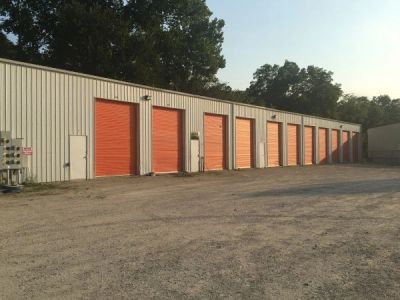
Rather than beginning in a laboratory, the Living Gravel Project begins on an operating commercial property at Lake of the Ozarks in Central Missouri.
Many self-storage properties have gravel driveways, drive sailes, and parking areas. No one tracks this information at the moment, but there are likely 5,000 to 10,000 self storage facilites in the USA that have some or all of its drive surfaces in gravel.
Lake Ozark Self-Storage, located off of Highway 54 close to the Highway W intersection at the Lake Of The Ozarks, has extensive gravel drive aisles, and has vegetation volunteering all around the property. We can call these volunteers into action to learn more and to develop a pilot site.
Different sections could be managed differently:
Traditional Gravel
Vegetation suppressed using conventional practices.
Volunteer Living Gravel
Naturally occurring vegetation allowed to establish, with undesirable species selectively controlled.
Managed Living Gravel
Promising volunteer species encouraged while inappropriate species are removed.
Seeded Living Gravel
Selected low-growing, traffic-tolerant vegetation deliberately introduced.
Researchers could then compare gravel loss, erosion, runoff, infiltration, vegetation coverage, surface temperature, maintenance requirements, appearance and cost.
Rainstorms become experiments.
Traffic becomes part of the experiment.
And instead of constructing an artificial research environment, researchers can observe how the treatments perform on an actual working property.
The Larger Question
The goal isn't to prove that vegetation should grow in every gravel surface.
Heavy-traffic roads and parking areas may require very different solutions from shoulders, parking margins, equipment-storage areas, secondary drives, and lightly traveled portions of commercial properties.
The goal is to determine where Living Gravel works, what should grow in it, and whether its benefits outweigh its costs.
If it does work, the potential application extends far beyond one property.
Gravel surfaces exist on farms, self-storage properties, construction yards, equipment lots, campgrounds, rural businesses, utility sites, parking areas, private roads and residential properties throughout Missouri and across the country.
Even a modest reduction in gravel loss, stormwater runoff and maintenance expense could have meaningful economic and environmental benefits when multiplied across thousands of properties.
The Idea
Sometimes the most practical solution isn't to defeat a natural process.
It is to understand it well enough to put it to work.
That is what we want to find out with Living Gravel.
How can you or your organization support this project or fold it into current projects?
Please reach out if you are already doing work in this area or if you'd like to particiapte in our project.
Current work on similar projects in Europe:
Resources and inspiration:
Schotterrasen (Living / Vegetated Gravel):
Schotterrasen & Vegetated Gravel: Technical Reference Guide
1. Executive Summary & Core Concept
Schotterrasen (literally "gravel turf" or "gravel lawn") is a standardized European civil engineering method (regulated under German FLL and FGSV standards) designed to produce load-bearing, fully permeable driving, parking, and access surfaces.
Rather than relying on impervious paving (asphalt/concrete) or loose, unstable gravel that suffers from washboarding, rutting, and dust migration, Schotterrasen integrates an angular crushed-rock structural skeleton with 10%–20% organic-mineral soil fractions and deep-rooting, drought-hardy vegetation.
2. Key Mechanical & Biological Principles
- Angular Stone Skeleton (Load Transfer): Crushed aggregate with sharp facets interlocks under mechanical compaction, creating rigid point-to-point contact bridges that distribute vehicle weight directly to the subgrade.
- Subsurface Root Tensile Mesh (Erosion Control): Grass and herb roots fill internal aggregate voids. The high tensile strength of the root network physically binds aggregate fines, eliminating washouts, dust, and tire rutting.
- Protected Crown Geometry: Tires ride on the protruding tops of the compacted stones. The vegetation crowns and root zones sit slightly recessed in the gravel pockets, shielded from direct wheel shear and crushing.
- Hydrological & Microclimate Performance: Achieves 100% on-site rainwater infiltration with a high permeability coefficient ($k_f \ge 1 \times 10^{-5}\text{ m/s}$), while plant transpiration drastically reduces surface heat compared to asphalt.
3. Layer Profiles & Cross-Section Specifications
Single-Layer Build (Light Traffic, Overflow Parking, Residential Tracks)
- Vegetated Structural Layer: 15–25 cm (6–10 in) of 0/32 mm angular stone pre-blended with 10%–15% compost/loam soil and seed.
- Subgrade: Compacted native subsoil ($\ge 30\text{ MN/m}^2$).
Two-Layer Build (Regular Driveways, Fire Access Lanes, Service Roads)
- Top Vegetated Layer: 10–15 cm (4–6 in) of 0/16 mm or 0/32 mm aggregate + 15%–20% soil fraction & seed mix.
- Structural Base Layer: 20–30 cm (8–12 in) of 0/45 mm or 0/56 mm unbound crushed stone (coarse ballast).
- Subgrade: Compacted subsoil with non-woven geotextile separation if subsoil is soft clay/silt.
4. Engineering Specifications
Aggregate Grading
0/32 mm (~1.25" minus) or 0/45 mm (~1.75" minus)
Provides structural ballast while retaining enough fine stone (0–4 mm) for seed anchorage.
Soil / Organic Content
10% to 20% by volume Balances moisture/nutrient retention with structural stability; prevents mud formation when wet.
Load Capacity
Engineered to support cars, delivery vans, and occasional heavy emergency/fire vehicles.
Water Permeability
Completely prevents standing water, ponding, and runoff fees.
Target Plant Cover
30% to 60% surface vegetation
Maintains green aesthetic while preserving stone vertices for tire contact.
5. Recommended Botanical Matrix
Species
Growth Form
Functional Role in Gravel Matrix
Festuca rubra (Creeping Red Fescue)
Rhizomatous grass
Forms a dense horizontal subsurface root web that locks aggregate fines together.
Festuca ovina (Sheep's Fescue)
Dwarf bunchgrass
Thrives in low-nutrient, high-drainage, shallow rocky conditions with minimal mowing.
Poa pratensis (Kentucky Bluegrass)
Stoloniferous grass
High recuperative capacity; regenerates quickly into tire wear paths.
Trifolium repens (Microclover / White Clover)
Prostrate legume
Fixes atmospheric nitrogen to feed companion grasses without synthetic fertilizer.
Achillea millefolium (Common Yarrow)
Taproot perennial forb
Deep root penetration through aggregate base into subgrade; resilient to wheel shear.
Thymus serpyllum (Wild Thyme)
Prostrate dwarf shrub
Low stature (1–2 inches); tolerates severe heat reflected from bare stone.
Sedum acre / album (Stonecrop)
Succulent ground cover
Thrives on driveway margins and center strips with zero irrigation or organic soil.
6. Installation & Establishment Workflow
- Subgrade Excavation: Excavate 20–40 cm depending on load profile; compact subgrade and pitch at 1.5%–2.5% for subsurface drainage.
- Substrate Blending: Thoroughly mix crushed angular aggregate (0/32 mm) with 10%–15% loam/compost prior to placement.
- Laying & Compaction: Spread substrate in 10–15 cm lifts; compact with a heavy vibratory plate or 2–4 ton roller until reaching stone-on-stone interlock.
- Seeding: Broadcast specialized seed mix (~20–25 g/m²), top-dress with a thin dusting (2–3 mm) of sharp sand/compost, and roll lightly.
- Establishment & Care: Keep moist for 3–4 weeks until roots establish. Mow 2–4 times per year with a high deck setting (7–10 cm / 3–4 in) to manage woody weeds.
7. Standards, Academic Research & Direct Sources
- FLL (Forschungsgesellschaft Landschaftsentwicklung Landschaftsbau e.V.):
- FGSV (Forschungsgesellschaft für Straßen- und Verkehrswesen):
- Standard: FGSV Technical Standards & Road Base Specifications (TL/ZTV SoB-StB)
- BOKU Vienna (Universität für Bodenkultur Wien – Institute of Soil Bioengineering):
- Research Profiles: Prof. Florin Florineth Research Index and Simone Längert BOKU Gravel Turf Investigation
- Bavarian State Institute for Viticulture and Horticulture (LWG Bayern):
- Field Research: LWG Urban Greenery & Permeable Surface Trials
- Rieger-Hofmann & Wildeblumen:
- Seed Formulations: Rieger-Hofmann Mischung 15 (Pflaster- und Schotterrasen) & Wildeblumen Saatgutmischung Schotterrasen
Perhaps we have a simlple way of accomplishing many of the outcomes of the European efforts by implementing what we learn at the Living Gravel pilot project. Please join us.
Please support the project by sharing this website with others who may find this interesting.
The pilot project
Maybe vegetation should be growing in gravel?
We'll see how the test goes, and share what we learn.
A real-world lab

We'll see what works for a self-storage facility with plenty of traffic and lots of gravel.